Manufacturer │ The difference is invisible — it's inside the
diamond cutter tool, not on it. This diamond cutter tool delivers a
rated cutting lifespan of 40‑60 linear meters in granite.
MINUTE 0 — TOUCH‑OFF
Clean bite. No dwell mark. Good. Clean bite. No dwell mark.
Identical to the electroplated diamond cutter tool on first
contact.
MINUTE 12 — CHARACTER 48
First sign of edge degradation. Line width at the serif terminus is
narrowing slightly. The operator doesn't adjust yet — it's within
tolerance — but it's noticeable on the monitor. Cutting action
unchanged. Feed rate still at the original setting. Line width
consistent with the first character. No adjustment needed for this
diamond cutter tool.
MINUTE 27 — CHARACTER 92
Edge is fading. The operator has dialed feed rate down 15% to
maintain line quality. Bottom of the groove shows micro‑chatter —
the grit layer is thinning unevenly. Estimated life remaining:
maybe 15 more characters. Still cutting at the original feed rate.
The self‑sharpening cycle is invisible to the naked eye — surface
diamond grains have fractured and released, fresh grains underneath
are now engaged. The operator hasn't touched the control panel
since minute 0, thanks to the self‑sharpening design of this
diamond cutter tool.
MINUTE 38 — CHARACTER 120
Didn't make it. Tool change at character 108. Total job time: 44
minutes including the swap. Two bits consumed on what should have
been a one‑bit job. Job complete. Full 120 characters, one diamond
cutter tool, zero adjustments. Total job time: 38 minutes. Tool
inspection post‑job: wear is uniform across the entire face of the
diamond cutter tool.
POST‑JOB
Surface quality on the second half (the part cut with bit #2) is
better than the first 48 characters, but the transition zone —
characters 48‑52 cut with the degrading bit — shows visible quality
variation. Intermediate sanding required on ~15% of the lettering
to even out the inconsistency. Surface quality is consistent from
character 1 to character 120. No sanding pass required. The diamond
cutter tool still has cutting life remaining and goes back into the
tool holder for the next job.
COST SUMMARY
Tools consumed: 2 bits Labor time: 44 min cutting + sanding Tool
cost per job: 2 × unit price Quality variance: present
Tools consumed: 1 diamond cutter tool (partial wear) Labor time: 38
min cutting, no sanding Tool cost per job: fraction of unit price
(still has remaining life) Quality variance: none
WHAT CREATES THE DIFFERENCE
Not speed. Both tools ran at the same RPM. Not operator skill. Same
machinist, same machine. Not stone quality. Same slab of granite.
The difference is structural — and it comes down to one question:
where does your cutting edge live?
ELECTROPLATED → The edge lives ON the tool. A single layer of grit. When it
wears through, the diamond cutter tool is dead.
VACUUM‑SINTERED → The edge lives IN the tool. Diamond particles suspended through
the full volume of a metal bond matrix. Surface grains wear → bond
erodes → fresh grains emerge. This repeats until the entire head is
consumed — not the surface, the entire head of your diamond cutter
tool.
THE MANUFACTURING STEPS THAT MAKE THIS POSSIBLE
Diamond Grading Particles sorted by size and quality. Ungraded grit = uneven
cutting action telegraphing onto the stone. Graded grit = uniform
tool face for every diamond cutter tool.
Mix Formulation Diamond blended with metal bond powder at ratios tuned to target
stone hardness. Harder bond for granite, softer bond for marble.
One formula does not fit all.
Cold Press Molding Powder compacted to uniform density. Density variation in the
pressed body = wear‑rate variation in the finished diamond cutter
tool. Hot spots fail first.
Vacuum Sintering Atmosphere evacuated before heating. Oxygen left in the furnace
becomes microscopic bubbles in the bond — voids where diamond
particles lose grip. Vacuum removes oxygen → near‑theoretical
density → every diamond particle fully embedded until it wears.
Finish Grinding Final profile, concentricity, edge geometry. Runout concentrates
cutting on one high spot. Precision grinding distributes wear
evenly across your diamond cutter tool.
STONE REFERENCE
Granite → Hard bond. No tool glazing in high‑quartz material.
Marble → Soft bond. Zero heat discoloration on white stone.
Bluestone → Matched bond keeps tool face open in dense basalt.
Sandstone → Cuts grains in place — no pullout, no pitted surface.
Engineered Quartz → Tuned bond for high‑hardness aggregate. No
loading. Limestone → Open bond structure. No clogging from soft
fines.
APPLICATIONS
Monument lettering / Portrait engraving / Architectural bas‑relief
Facade panels / Dimensional signage / 3D sculptural roughing
Countertop edge profiles / Floor medallions / Surface texturing
ORDERING
Stock: Standard engraving diameters and common profiles. Custom:
Grit size, bond hardness, tip geometry, shank dimensions —
formulated to your stone and your machine.


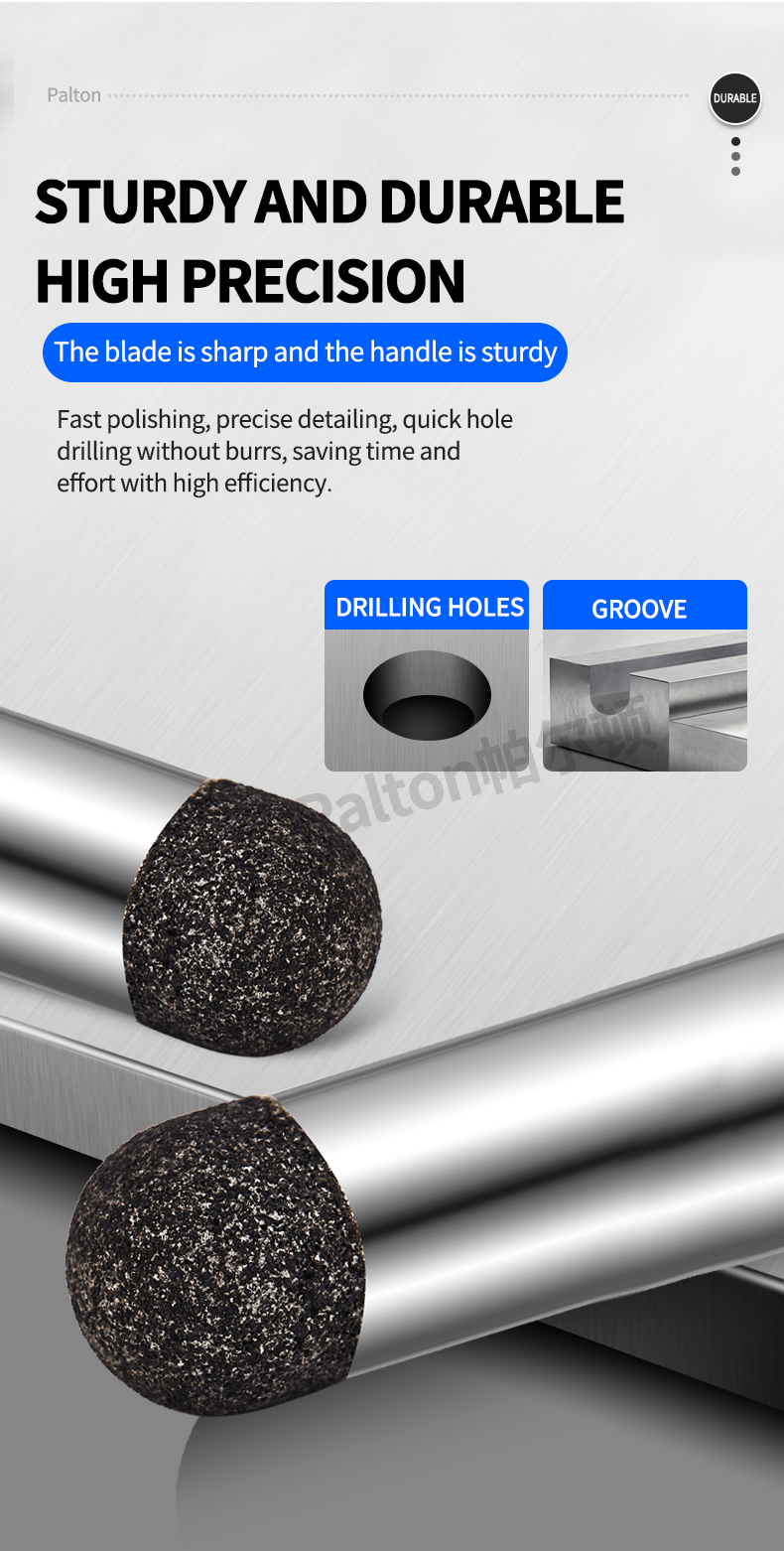


 Industrial Milling Diamond Cutter Tool CNC Stone Engraving Router Bits

