Self-Compensating CNC Grinding Machine For Brass Valve
Self-Compensating CNC Grinding Machine for Brass Valves —
Micron-Level Accuracy, Unattended, All Shift Long
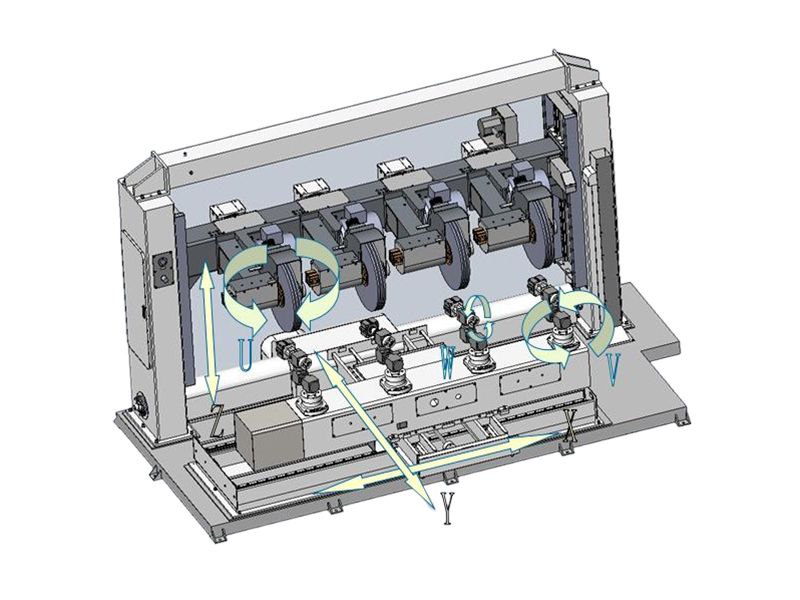
Product Overview
Brass valve components are among the most tolerance-sensitive
workpieces in fluid control manufacturing. A valve seat ground 0.01
mm out-of-round leaks. A stem ground 0.005 mm oversize binds. A
ball ground with inconsistent sphericity fails the pressure test.
Traditional CNC grinding machines treat wheel wear as an operator
problem — as the wheel dulls and loads, diameter creeps, surface
finish degrades, and the operator must stop the line, manually
dress the wheel, re-measure, and re-offset. On a high-volume brass
valve line running 3 shifts, this happens dozens of times per day.
The LRMC-BV Series Self-Compensating CNC Grinding Machine
eliminates this cycle entirely. An in-process gauging probe
measures every ground feature in real time. The CNC controller
computes the dimensional deviation, calculates the required
compensation offset, and adjusts the wheel infeed position — all
within the same machining cycle, without stopping the spindle or
interrupting production.
The result: ±0.003 mm dimensional consistency from the first valve
of the shift to the last, with no operator intervention, no
mid-batch measurement stops, and no scrap from wheel-wear drift.
Key Features
1. In-Process Self-Compensation — Closed-Loop Dimensional Control
The core differentiator of the LRMC-BV is its integrated in-process
gauging and automatic compensation loop:
- In-process probe: air gauging or LVDT contact probe measures ground diameter /
roundness / seat angle during or immediately after each grinding
pass
- Compensation algorithm: CNC controller computes deviation from nominal and applies infeed
offset before the next workpiece — no operator input required
- Compensation range: up to ±0.15 mm wheel-wear offset, auto-applied in increments as
small as 0.0005 mm
- Dimensional tolerance maintained: ±0.003 mm (diameter), ±0.002 mm (roundness) across full batch
- Automatic wheel dress trigger: when compensation offset accumulates beyond the set threshold, the
dresser engages automatically between cycles — zero production
interruption
Result: dimensional drift that previously caused 3-8% scrap on long
runs is reduced to < 0.3%.
2. Brass-Optimized Grinding Parameters — No Smearing, No Built-Up
Edge
Brass is a soft, ductile material that smears on conventional
grinding wheels, causing built-up edge, wheel loading, and sudden
surface finish collapse. The LRMC-BV is configured specifically for
brass:
- CBN / vitrified alumina wheel selection: matched to brass hardness (HB 60-120) to minimize smearing
- High wheel speed + low infeed rate: prevents ductile tearing and maintains sharp cutting action
- Flood coolant with brass-compatible chemistry: prevents dezincification and thermal discoloration
- Automatic wheel balance: dynamic balancing compensates for wheel loading as brass swarf
accumulates
- Chip flushing: high-pressure coolant flush clears brass swarf from wheel face
between passes
3. Servo-Driven Axes — Sub-Micron Positioning Resolution
All grinding axes are servo-driven with linear scale feedback:
- X-axis (infeed) resolution: 0.0001 mm (0.1 µm)
- Z-axis (traverse) resolution: 0.001 mm
- C-axis (workhead rotation): ±0.001°
- Backlash: zero (linear scale closed-loop)
- Thermal compensation: automatic offset correction based on spindle temperature sensor
4. Automatic Loading & Unloading Integration (Optional)
For brass valve lines running > 5,000 pcs/shift, the LRMC-BV
integrates with:
- Robot arm pick-and-place (from conveyor or pallet)
- Pneumatic collet / hydraulic chuck auto-clamp
- Post-grind gauging station with pass/fail sorting
- Reject bin diversion for out-of-tolerance parts
- Throughput: up to 400 valve bodies/hour (body bore grinding cycle)
5. Multi-Recipe Production Management
The CNC controller stores dedicated grinding programs for each
valve type:
- Recipe storage: 1,000+ CNC programs
- Program parameters: wheel speed, infeed rate, spark-out passes, compensation
sensitivity, dress interval, coolant flow
- Changeover between valve sizes: < 8 minutes (program recall + collet/chuck swap)
- Barcode / RFID-triggered auto-recipe selection (optional)
System Configuration Options
Precision Cell — LRMC-BV-P
- CNC grinding machine, 4-axis servo
- In-process LVDT gauging probe
- Automatic wheel dresser (diamond roll)
- Collet chuck workhead (Ø8-65 mm valve range)
- Flood coolant with brass-compatible chemistry
- HMI + 1,000-recipe CNC storage
- Manual load/unload
Production Cell — LRMC-BV-A
- All Precision features, plus:
- Air gauging in-process probe (non-contact, faster response)
- Robot arm auto-loading from conveyor/pallet
- Post-grind pass/fail sorting station
- SPC process monitoring (Cp / Cpk trending per batch)
- OPC-UA / MQTT MES connectivity
- Remote diagnostics module
Frequently Asked Questions
Q: What makes "self-compensating" different from standard CNC
offset adjustment?
A: Standard CNC offset adjustment is operator-triggered — the
operator measures a part, sees drift, and manually enters a new
offset. Self-compensating means the machine measures every part
itself (in-process probe), computes the required offset, and
applies it automatically before the next cycle. The operator is
removed from the compensation loop entirely. On a 3-shift brass
valve line, this eliminates 15-30 manual measurement stops per
shift.
Q: Brass is soft and tends to smear grinding wheels. How does the
machine handle this?
A: The LRMC-BV uses CBN or vitrified alumina wheels matched to
brass hardness (HB 60-120). High wheel peripheral speed combined
with low infeed rate prevents ductile tearing and smearing.
High-pressure coolant flush clears brass swarf from the wheel face
between passes. Automatic dynamic wheel balancing compensates for
uneven swarf loading. Together, these measures maintain consistent
cutting action across the full dress interval.
Q: Can one machine grind both the valve bore and the seat angle in
the same setup?
A: Yes, with the Multi-Operation Cell (LRMC-BV-M). An automatic
grinding wheel exchange system switches between the bore-grinding
wheel and the angle-dressed seat wheel within the same clamping —
eliminating re-chucking error and reducing total cycle time by
35-50% compared to two separate machines.

 Automatic CNC Grinding Machine Deburring Station for Stainless Steel Casting Parts

